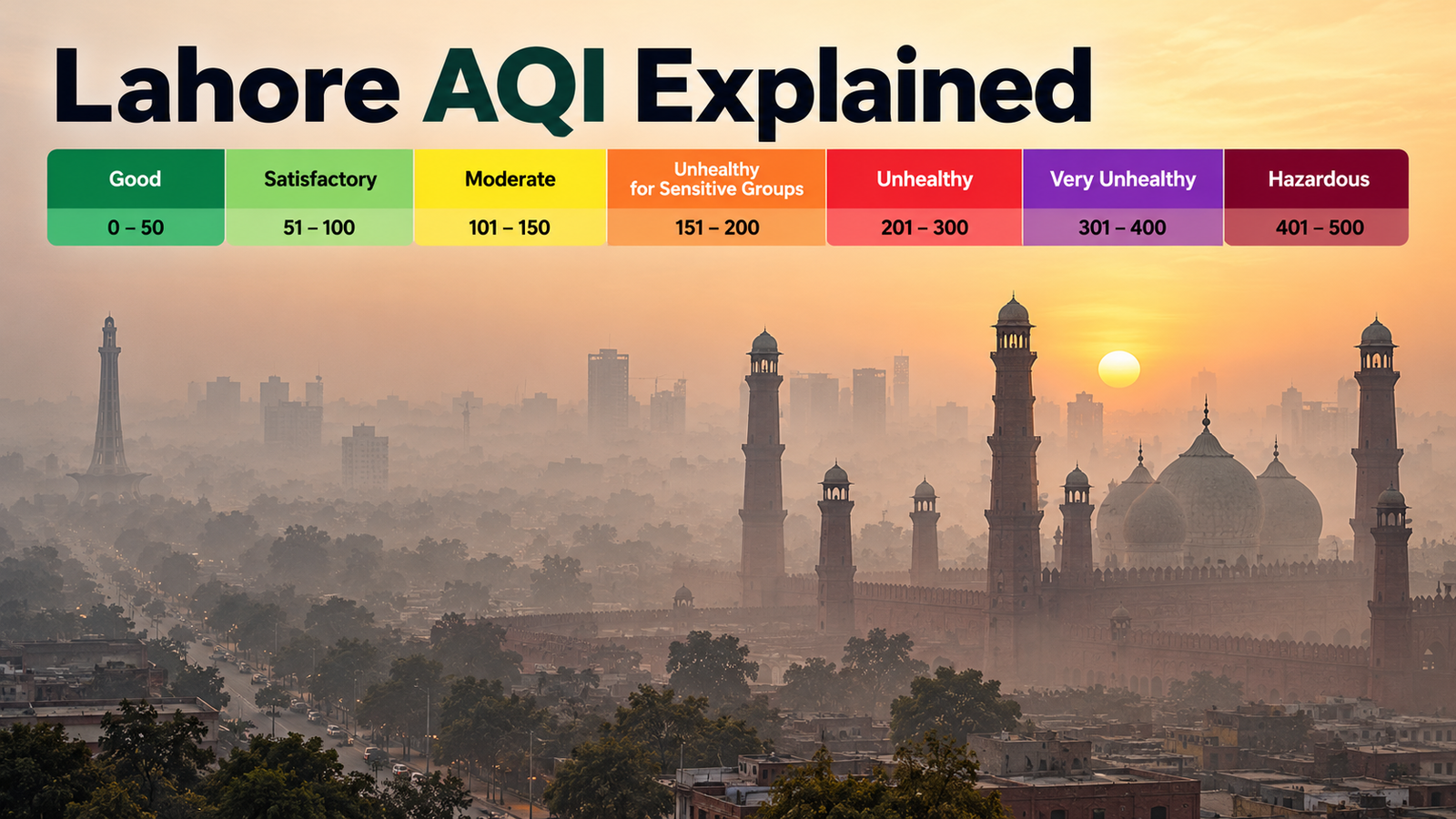
Lahore AQI is more than a number on your phone. It can help you decide whether to go for a morning walk, send children outdoors for sports, or take extra precautions during a polluted day.
But what does an AQI reading of 100, 200 or 300 actually mean? And is there a number below which Lahore’s air is completely safe?
The answer is more complicated than a simple green or red indicator.
Lahore’s Air Quality Index translates measured air pollution into categories that help communicate potential health risks. Higher readings generally mean greater concern, but the risks also depend on the pollutants involved, how long someone is exposed and their individual health.
This guide explains Lahore’s seven official AQI categories, the difference between AQI and PM2.5, how weather affects pollution, and practical ways to make informed decisions.
Want to check the conditions before heading outside? Explore Lahore’s weather forecast on GenWeather and consult the Punjab EPA’s official Lahore AQI dashboard for air-quality measurements.
Table of Contents
What Is Lahore AQI?
The Lahore AQI is an air-quality index used to communicate the severity of outdoor air pollution and its potential effects on health.
Rather than requiring people to interpret several pollutant concentrations separately, an AQI presents an easier-to-understand scale.
For example, an air-quality reading can help answer questions such as:
- Is outdoor air quality relatively good today?
- Should children reduce strenuous outdoor activities?
- Is it advisable to exercise outside?
- Could people with asthma or heart conditions need extra precautions?
- Are conditions improving or deteriorating?
However, AQI is not a medical diagnosis, and it does not measure the exact amount of pollution a particular person inhales.
Why Lahore AQI Matters Beyond Smog Season
Many people associate Lahore’s air pollution with the hazy winter months.
Yet pollution can remain a concern outside the main smog season.
Vehicle exhaust, industrial emissions, dust, construction activity and other sources can affect air quality at different times of year.
This is why checking AQI should not be limited to days when the sky looks visibly polluted.
For a detailed explanation of seasonal patterns, read our Lahore Smog Season: Dates, Causes & AQI Guide.
Lahore AQI Levels: What Do the 7 Categories Mean?
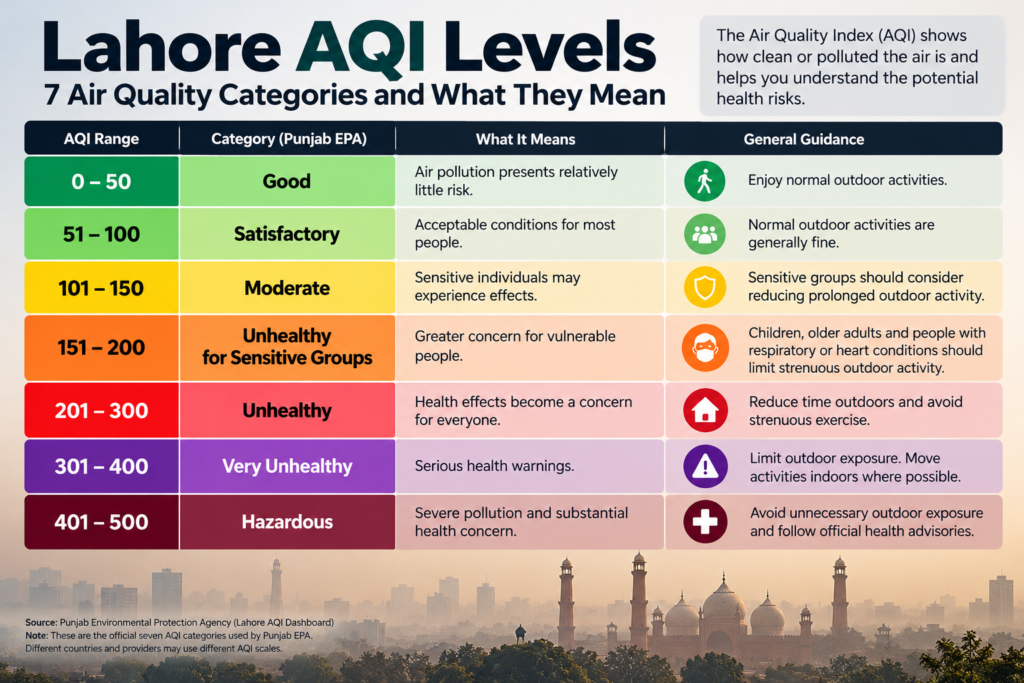
Punjab’s Environmental Protection Agency publishes seven AQI categories on its Lahore monitoring dashboard.
These categories help readers understand increasing levels of air-quality concern.
| AQI range | Official category | What it generally means |
|---|---|---|
| 0-50 | Good | Air pollution presents relatively little risk |
| 51-100 | Satisfactory | Acceptable conditions for most people |
| 101-150 | Moderate | Sensitive individuals may experience effects |
| 151-200 | Unhealthy for Sensitive Groups | Greater concern for vulnerable people |
| 201-300 | Unhealthy | Health effects become a concern for everyone |
| 301-400 | Very Unhealthy | Serious health warnings |
| 401-500 | Hazardous | Severe pollution and substantial health concern |
Source: Punjab Environmental Protection Agency, Lahore AQI dashboard. Other countries and providers may use different AQI scales.
1. Good AQI: 0-50
A reading between 0 and 50 falls within Punjab EPA’s Good category.
Outdoor air quality is generally favorable, and normal activities are usually appropriate for most people.
However, no AQI category guarantees zero health risk, particularly for individuals with unusual sensitivities.
2. Satisfactory AQI: 51-100
A reading from 51 to 100 is classified as Satisfactory.
Most people can usually continue normal outdoor activities.
Those who are particularly sensitive to air pollution should still pay attention to symptoms and local conditions.
3. Moderate AQI: 101-150
At 101-150, Lahore’s air quality falls into the Moderate category.
People with respiratory or cardiovascular conditions, older adults and children may be more affected by prolonged exposure.
For vulnerable individuals, reducing lengthy or strenuous outdoor activity may be sensible.
4. Unhealthy for Sensitive Groups: 151-200
An AQI of 151–200 means air pollution may pose greater risks to sensitive groups.
Children, older adults and people with asthma, COPD or heart disease should consider avoiding prolonged outdoor exertion.
The general population may be less affected, but symptoms and individual circumstances still matter.
5. Unhealthy AQI: 201-300
At 201-300, the air is classified as Unhealthy.
Health effects become a concern for the wider population, with potentially more serious consequences for vulnerable groups.
Reducing time outdoors and avoiding strenuous outdoor exercise can help limit exposure.
6. Very Unhealthy AQI: 301-400
A reading of 301-400 represents Very Unhealthy air quality.
At this level, serious health warnings apply, and exposure reduction becomes particularly important.
Consider moving activities indoors, limiting unnecessary outdoor exposure and following official health advisories.
7. Hazardous AQI: 401-500
The highest category on Punjab EPA’s published scale is Hazardous.
These readings indicate extremely poor air quality and significant health concern.
People should follow official instructions, avoid unnecessary outdoor exposure and take appropriate precautions to improve indoor air quality.
If you experience severe breathing difficulty, chest pain or other serious symptoms, seek urgent medical attention.
What Is a Safe AQI in Lahore?
A common question is: What is the safe AQI level in Lahore?
On Punjab EPA’s scale, 0-50 is the most favorable category, while 51-100 is generally considered satisfactory.
But the word safe needs care.
There is no universal AQI value that guarantees every person will experience no health effects.
Risk depends on several factors, including:
- The type and concentration of pollutants.
- How long someone is exposed.
- Whether they are exercising or breathing heavily.
- Existing respiratory or cardiovascular conditions.
- Age and individual sensitivity.
A lower AQI is generally preferable, but a single reading cannot capture someone’s entire exposure history.
Is AQI 100 Safe for Outdoor Exercise?
An AQI around 100 is near the upper end of Punjab EPA’s Satisfactory category.
Many healthy adults may be able to continue normal activities, but people who are unusually sensitive should consider their symptoms and the latest local advice.
Long outdoor workouts also produce greater inhaled exposure than brief, low-intensity activities.
Is AQI 200 Dangerous?
An AQI around 200 is at the upper boundary of Unhealthy for Sensitive Groups on Punjab’s scale.
This is not a good time for vulnerable people to undertake strenuous outdoor exercise.
Readings just above 200 enter the Unhealthy category, where the wider population may also experience effects.
What About AQI 300 or Higher?
An AQI of 300 is at the top of Punjab EPA’s Unhealthy category, and readings above 300 are classified as Very Unhealthy.
These conditions call for substantial exposure reduction and careful attention to official guidance.
Lahore AQI vs PM2.5: What’s the Difference?
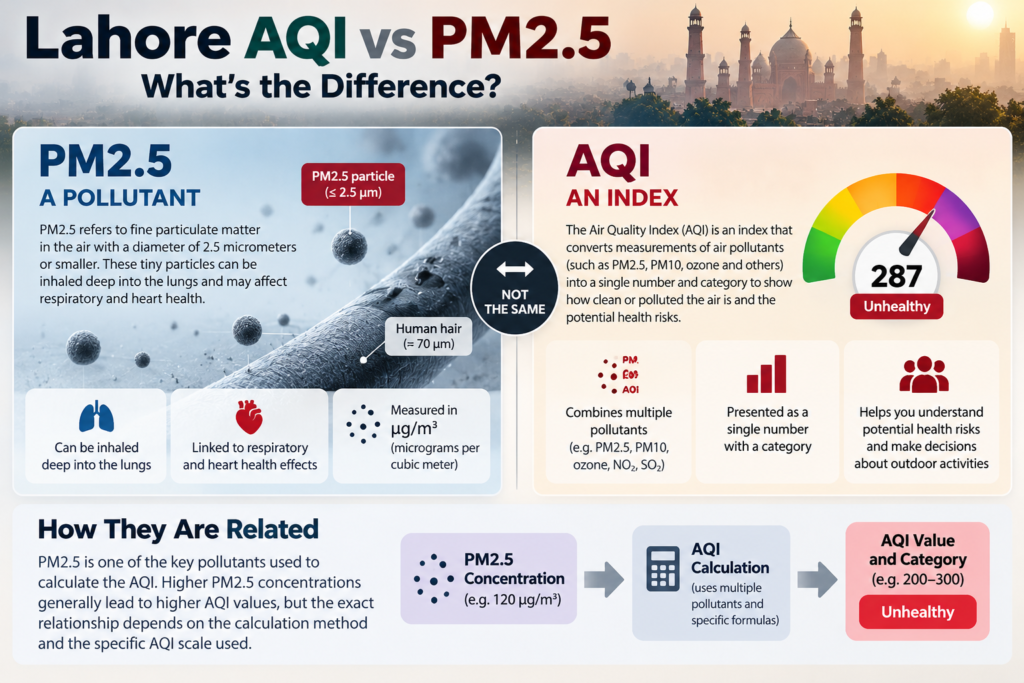
AQI and PM2.5 are closely related, but they are not the same measurement.
AQI is an index used to communicate air-quality concern.
PM2.5 is a type of air pollutant: fine particulate matter with an aerodynamic diameter of 2.5 micrometers or smaller.
PM2.5 concentrations are commonly reported in micrograms per cubic meter (µg/m³).
AQI values are dimensionless index numbers.
A PM2.5 concentration of 100 µg/m³ is therefore not automatically equivalent to an AQI of 100.
The relationship depends on the calculation method, averaging period and applicable index scale.
Why Is PM2.5 Important?
Fine particles can penetrate deep into the respiratory system.
Exposure to particulate pollution is associated with adverse effects on lung and cardiovascular health.
PM2.5 is especially important because its small size allows it to remain suspended in the atmosphere and be inhaled.
What Does the World Health Organization Recommend?
The World Health Organization’s 2021 air-quality guidelines recommend:
- PM2.5 annual mean: 5 µg/m³.
- PM2.5 24-hour mean: 15 µg/m³, assessed using the guideline’s specified statistical convention.
These are pollutant concentration guidelines, not AQI scores.
That distinction matters when comparing information from different air-quality websites.
You can read the WHO Global Air Quality Guidelines for more detail.
Why Does Lahore AQI Change Throughout the Day?
Lahore’s AQI can change even when the main sources of pollution remain relatively constant.
That’s because weather affects how pollutants move, disperse and accumulate.
Morning Temperature Inversions
During cooler periods, an atmospheric temperature inversion can restrict vertical mixing.
Pollutants may accumulate closer to the ground, particularly when winds are weak.
This can contribute to poor air quality during some mornings.
Afternoon Mixing
As the ground warms, atmospheric mixing may improve.
This can help disperse some pollutants.
However, stronger mixing does not guarantee good air quality, and different pollutants can follow different daily patterns.
Wind Direction and Speed
Wind can transport pollution away from one neighborhood while bringing pollutants into another.
This is one reason air-quality measurements may differ between monitoring stations.
Rainfall
Rain can remove some particles from the atmosphere.
But its effects depend on the type and intensity of precipitation and subsequent weather conditions.
A rainy day is not automatically a pollution-free day.
For the weather context behind these changes, check the GenWeather Lahore forecast.
Where to Check Lahore AQI Today
If you’re searching for Lahore AQI today, use a source that identifies the measurement location and provides recent data.
The Punjab EPA Lahore AQI dashboard publishes readings from monitoring stations across the city.
Before relying on a number, check four things.
1. The Monitoring Location
A reading from one station may not describe conditions across every neighborhood of Lahore.
Traffic, dust, nearby emissions and wind conditions can all affect local measurements.
2. The Update Time
AQI can change during the day.
A reading from several hours ago may not reflect current conditions.
3. The AQI Scale
Different providers may use different AQI breakpoints.
For example, the US EPA’s AQI system has six categories, while Punjab EPA’s published Lahore dashboard uses seven.
Two websites may display different index numbers or labels even when reporting similar pollutant measurements.
4. The Pollutant and Averaging Period
Check whether the reading is based on PM2.5, PM10 or another pollutant.
Also look for the averaging period, where available.
A short-term reading and a daily average are not necessarily directly comparable.
Important: This article does not display a fixed “current Lahore AQI” number because air-quality readings change. Always check a live, timestamped monitoring source.
How to Protect Yourself When Lahore AQI Is High
You cannot control the city’s outdoor air quality on your own, but you can make decisions that reduce exposure.
Adjust Outdoor Exercise
On polluted days, consider moving running, cycling or other strenuous activities indoors.
Physical exertion increases breathing rates and can increase the amount of polluted air inhaled.
Protect Indoor Air
During severe outdoor pollution episodes, limiting the entry of outdoor particles can help.
A properly sized HEPA air purifier may reduce indoor particulate concentrations.
Avoid indoor smoking, unnecessary burning and other activities that add pollution.
Use Appropriate Respiratory Protection
A properly fitted N95, KN95 or equivalent particulate respirator can help reduce exposure to fine particles.
Fit matters, and these respirators do not protect against every type of gaseous pollutant.
Pay Special Attention to Vulnerable Groups
Children, older adults, pregnant people and those with existing respiratory or cardiovascular conditions may need additional precautions.
Follow guidance from qualified health professionals when managing individual medical conditions.
Avoid Relying on Visibility Alone
A clear-looking sky does not guarantee clean air.
Some harmful pollutants are invisible, and haze can have multiple causes.
Measured AQI is more informative than appearance alone.
Should Lahore Schools and Outdoor Sports Change Activities Based on AQI?
Schools, sports clubs and outdoor event organizers should consider air-quality readings when planning activities.
High-intensity exercise can increase inhaled pollution exposure, particularly among children and athletes.
Practical decisions may include:
- Moving physical education indoors during severe pollution.
- Rescheduling outdoor sports where feasible.
- Reducing prolonged exertion during unhealthy conditions.
- Following official school and public-health advisories.
- Rechecking air quality if conditions change.
This article does not establish an official threshold for school closure.
School closures and government restrictions should only be reported when confirmed by the relevant authorities.
Why Lahore Needs Better Air Quality Awareness Year-Round
Lahore’s winter smog receives widespread attention because it is often visible and disruptive.
But pollution doesn’t become harmless when the haze disappears.
Long-term exposure matters, and effective improvements require sustained reductions in emissions.
Monitoring helps residents understand the problem, while public policy, cleaner technologies and enforcement address pollution at its sources.
For a deeper explanation of seasonal causes, read our Lahore Smog Season Guide.
Frequently Asked Questions About Lahore AQI
What is Lahore AQI?
Lahore AQI is an index that communicates outdoor air-pollution levels and their potential health implications.
What is a good AQI in Lahore?
On Punjab EPA’s scale, an AQI of 0–50 is Good, and 51–100 is Satisfactory.
Is Lahore AQI 150 safe?
An AQI of 150 falls at the upper end of the Moderate category on Punjab EPA’s scale. Sensitive individuals may need to reduce prolonged or strenuous outdoor activity.
Is Lahore AQI 200 unhealthy?
An AQI of 200 is at the upper boundary of Unhealthy for Sensitive Groups on Punjab EPA’s scale. Readings above 200 enter the Unhealthy category.
Why is Lahore AQI worse in winter?
Cooler conditions, weak winds and temperature inversions can reduce pollutant dispersion, while emissions from multiple sources continue.
Can rain improve Lahore AQI?
Rain may temporarily remove some airborne particles, but it does not eliminate the sources of pollution.
Is PM2.5 the same as AQI?
No. PM2.5 is a pollutant measured as a concentration, while AQI is an index communicating pollution-related health concern.
Where can I see Lahore AQI today?
Check the Punjab EPA’s Lahore monitoring dashboard for recent readings, station details and available updates.
Final Thoughts
Understanding Lahore AQI helps turn confusing pollution numbers into more informed everyday decisions.
The most important lessons are simple: lower readings are generally better, different AQI systems should not be confused, and pollution exposure depends on more than one number.
Check official monitoring data, pay attention to your personal health circumstances, and adjust outdoor activities when air quality deteriorates.
For additional context, explore Lahore’s weather forecast on GenWeather and our complete guide to Lahore’s smog season.
Sources and Further Reading
- Punjab Environmental Protection Agency: Lahore AQI Dashboard
- World Health Organization: Global Air Quality Guidelines
- US EPA AirNow: Using the Air Quality Index
- US EPA AirNow: Air Quality and Your Health
Editorial note: This article is intended for general education and is not a substitute for official real-time monitoring, public-health advisories or individualized medical guidance.