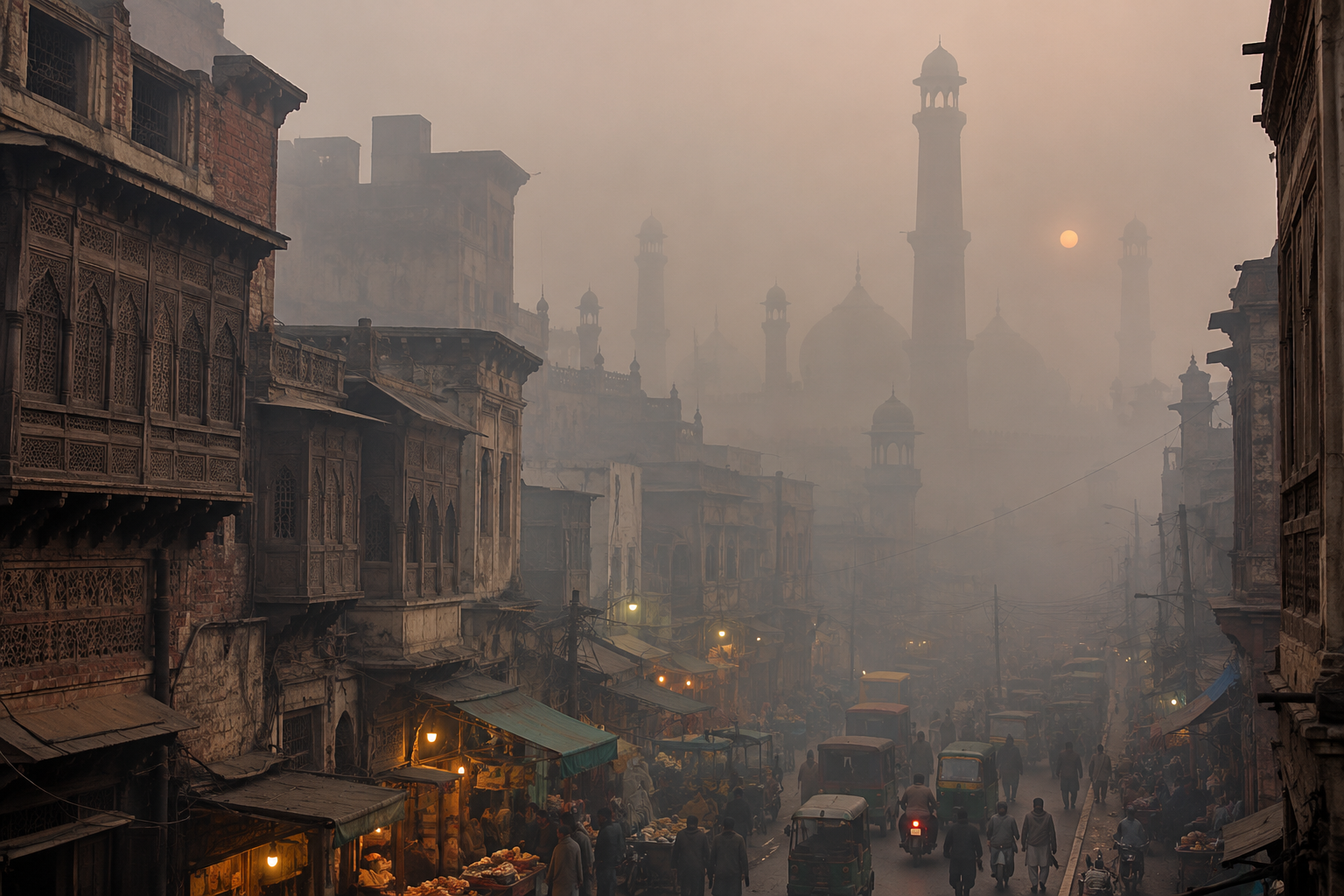
Every autumn, Lahore faces a familiar problem. The mornings become hazier, visibility drops, and residents begin checking air quality readings before heading outdoors.
But when does Lahore’s smog season actually start, when does it end, and why does the problem become worse during winter?
Lahore’s most challenging smog period generally falls between October and February, although the intensity and duration vary from year to year. Pollution can occur throughout the year, but cooler temperatures, stagnant air and seasonal emissions can make autumn and winter particularly difficult.
This guide explains Lahore’s smog season month by month, the science behind winter pollution, how to interpret the Air Quality Index (AQI), and practical precautions for residents and visitors.
For local conditions and upcoming weather changes, explore the Lahore weather forecast on GenWeather.
Table of Contents
When Does Smog Season Start in Lahore?
Lahore’s smog season typically begins to become more noticeable in October, when autumn weather patterns start changing.
During this period, several factors can combine:
- Cooler nights can encourage temperature inversions.
- Light winds may allow pollutants to accumulate.
- Vehicle and industrial emissions continue throughout the day.
- Seasonal crop residue burning can contribute additional smoke.
- Dry weather may reduce the removal of airborne particles.
The beginning of smog season is not a fixed date. Some years bring severe pollution episodes earlier, while others experience more gradual deterioration.
Pakistan’s National Disaster Management Authority (NDMA) identified October as an important period for the development of winter smog conditions in its 2025 climate assessment.
Which Months Have the Worst Smog in Lahore?
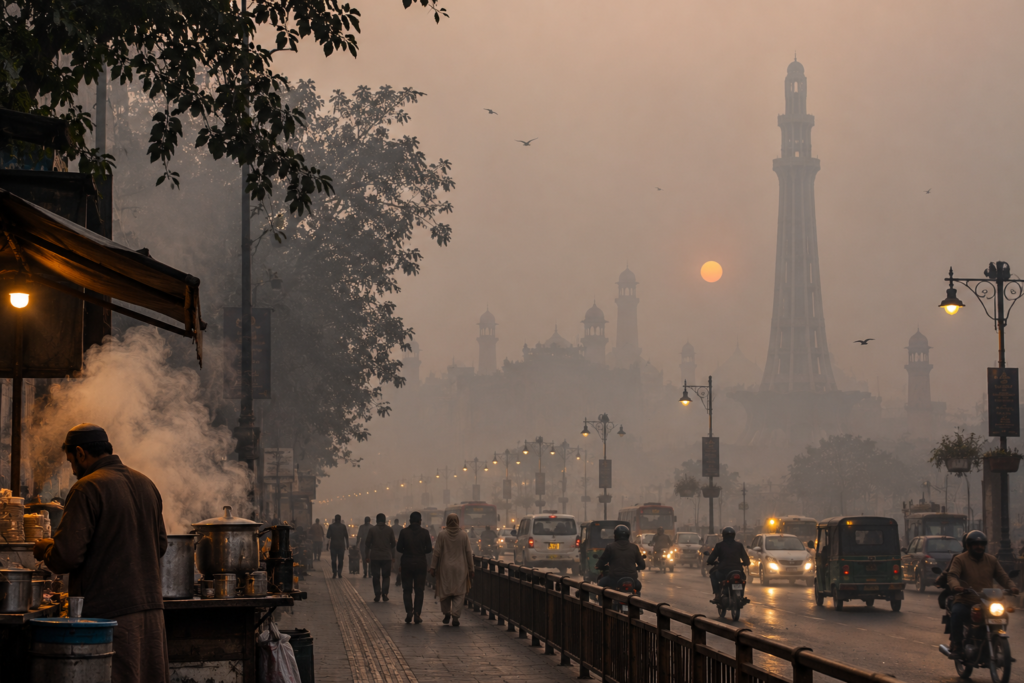
November and December are often among Lahore’s most difficult months for air quality, but serious pollution can continue into January and February.
October: The Smog Season Begins
October marks the transition from warmer conditions toward cooler autumn nights.
Temperature inversions may become more frequent, and air pollution can build up during periods of limited wind.
Residents may notice hazy mornings, reduced visibility and deteriorating AQI readings, although conditions can vary considerably from day to day.
November: Pollution Episodes Intensify
November is commonly associated with severe smog episodes in Lahore.
Cooler temperatures, seasonal emissions and stagnant weather can cause fine particles to accumulate near the ground.
Outdoor exercise, commuting and travel may become more difficult during particularly polluted periods.
December: Winter Smog and Reduced Visibility
December can bring persistent air pollution, especially during prolonged dry and calm conditions.
Fog may also develop during winter mornings. When fog and high concentrations of pollutants occur together, visibility can deteriorate substantially.
However, fog and smog are not the same thing. Fog consists primarily of suspended water droplets, while smog contains air pollutants.
January: Cold Weather and Continuing Pollution
January is generally one of Lahore’s coolest months.
Cold nights and stable atmospheric conditions can continue to trap pollution near the surface.
Rainfall or stronger winds may temporarily improve air quality, but a short-lived improvement does not necessarily mean the smog season has ended.
February: Conditions May Begin to Improve
As winter transitions toward spring, changes in temperature, wind and atmospheric mixing can help disperse pollutants more effectively.
Nevertheless, unhealthy air quality remains possible.
The end of the smog season should be judged by sustained improvements in measured pollution, not simply by the arrival of February.
Why Is Lahore’s Smog Worse in Winter?
Lahore’s winter smog is the result of both pollution emissions and weather conditions.
Pollution sources release harmful substances into the atmosphere throughout the year. Winter weather can make it harder for those substances to disperse.
1. Temperature Inversions Trap Pollution
Under normal circumstances, warmer air near the surface can rise and mix with air above it.
During a temperature inversion, a layer of warmer air sits above cooler air close to the ground.
This reduces vertical mixing and can trap pollutants near the places where people live, work and travel.
Temperature inversions do not create pollution themselves. They make existing pollution harder to disperse.
2. Vehicle Emissions Add to the Problem
Lahore’s road traffic contributes emissions from cars, motorcycles, buses and trucks.
Combustion-related emissions can contribute directly or indirectly to concentrations of harmful particles and gases.
Heavy traffic and congestion can worsen exposure along busy roads.
3. Industrial Activity and Brick Kilns Contribute Emissions
Industrial facilities, fuel combustion and brick kilns can release particles and gases that contribute to regional air pollution.
The contribution of each source varies by location, season and operating conditions.
4. Crop Residue Burning Can Increase Seasonal Pollution
Agricultural burning can add smoke and fine particles to the atmosphere during parts of the autumn season.
Pollution can also travel across district and national boundaries.
However, Lahore’s smog cannot accurately be attributed to a single source or country. Local emissions, regional transport and meteorological conditions all matter.
5. Weak Winds and Dry Conditions Allow Pollution to Build Up
Wind can disperse pollutants, while rainfall can remove some airborne particles.
When winds are weak and the weather remains dry, pollution may accumulate over several days.
This helps explain why Lahore’s AQI can change significantly even when traffic and other emissions appear relatively similar.
What Is Lahore’s AQI and Why Does It Matter?
The Air Quality Index (AQI) is a simplified way to communicate air pollution levels and their potential health implications.
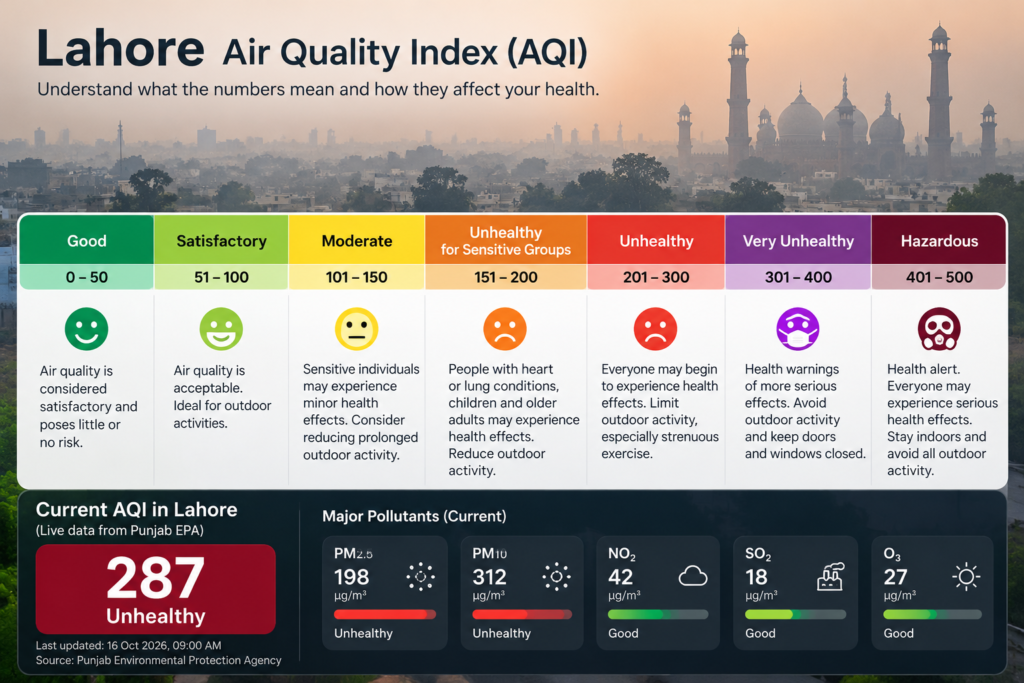
An AQI reading is not the same as a temperature or weather forecast.
A city can have sunny skies and comfortable temperatures while still experiencing unhealthy air pollution.
The Punjab Environmental Protection Agency operates an official air-quality monitoring platform that publishes Lahore readings from multiple monitoring stations.
You can check the official Lahore AQI dashboard for updated measurements.
Understanding Lahore’s Official AQI Categories
The Punjab EPA dashboard uses the following categories:
| AQI | Category |
|---|---|
| 0-50 | Good |
| 51-100 | Satisfactory |
| 101-150 | Moderate |
| 151-200 | Unhealthy for Sensitive Groups |
| 201-300 | Unhealthy |
| 301-400 | Very Unhealthy |
| 401-500 | Hazardous |
These categories describe increasing levels of concern.
Different AQI systems can use different breakpoints and labels. When comparing readings from separate websites, check which scale each provider uses.
Why Can Lahore’s AQI Differ Between Areas?
Lahore is a large city, and pollution is not distributed evenly.
Readings can differ between neighborhoods because of traffic, industrial activity, wind direction, local dust sources and other conditions.
That means one citywide number may not accurately describe the air quality outside every home, school or workplace.
Where possible, check the monitoring station closest to your location and note the time of the reading.
What Is PM2.5 and Why Is It Dangerous?
PM2.5 refers to fine airborne particles with diameters of 2.5 micrometers or smaller.
These particles are especially concerning because they can travel deep into the lungs, and some can enter the bloodstream.
Exposure to air pollution is associated with respiratory and cardiovascular health risks.
Children, older adults, pregnant people and individuals with existing heart or lung conditions may be especially vulnerable.
The World Health Organization identifies fine particulate pollution as a major public-health concern.
For detailed information, consult the WHO’s air pollution health guidance.
How Does Weather Affect Lahore’s Smog?
Weather influences how quickly pollution builds up and how effectively it disperses.
Understanding these relationships can help explain changes in AQI.
Does Rain Reduce Smog?
Rain can remove some particles from the atmosphere and may temporarily improve air quality.
However, the size and duration of the improvement depend on rainfall intensity, pollutant levels and what happens afterward.
Rain is not a permanent solution to air pollution.
Does Wind Clear Smog?
Stronger winds can disperse pollutants and improve local air quality.
But wind can also transport pollution from other areas, so the outcome depends on wind direction and regional conditions.
Is Fog the Same as Smog?
No.
Fog consists mainly of tiny water droplets suspended near the ground.
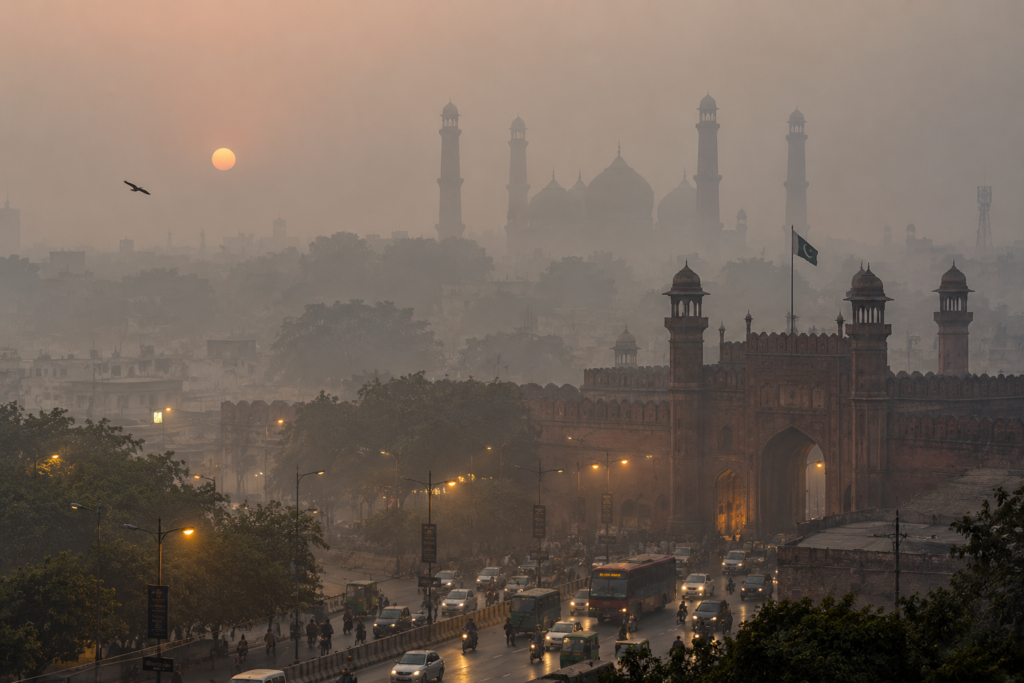
Smog involves airborne pollutants such as fine particles and gases.
The two can occur together, making winter conditions particularly unpleasant and sometimes reducing visibility.
Does Cold Weather Cause Smog?
Cold temperatures alone do not cause smog.
However, winter conditions can encourage temperature inversions and reduced atmospheric mixing, which allow existing emissions to accumulate.
How to Reduce Exposure During Lahore’s Smog Season
Individual precautions can help reduce exposure during Lahore smog season, but they do not replace the need for effective emissions control.
Check AQI Before Outdoor Activities
Look at recent local readings before planning running, cycling, outdoor sports or extended travel.
When air quality is unhealthy, consider shortening or rescheduling strenuous outdoor activities.
Use a Well-Fitting Particle Respirator When Appropriate
A properly fitted N95, KN95 or equivalent particulate respirator can help reduce inhalation of fine particles.
Ordinary cloth or loose-fitting surgical masks do not offer the same level of protection against fine particulate pollution.
Respirators must fit properly to work effectively, and they do not protect against all gaseous pollutants.
Improve Indoor Air Quality
During severe outdoor pollution episodes, reducing the entry of outdoor particles may help.
A suitable HEPA air purifier can reduce indoor particulate concentrations when correctly sized and operated.
Avoid indoor smoking and unnecessary burning, which add pollution inside the home.
Take Extra Care With Children and Vulnerable Family Members
Children, older adults and people with asthma or heart and lung conditions may need additional precautions.
Follow medical advice for existing conditions and seek urgent medical care for serious symptoms such as chest pain or significant difficulty breathing.
The World Health Organization’s guidance on personal interventions explains both the potential benefits and limitations of individual protection measures.
Driving and Traveling During Lahore’s Smog Season
Smog and winter fog can reduce visibility on city roads and major highways.
Before traveling:
- Check current weather and visibility conditions.
- Look for official motorway and traffic advisories.
- Allow additional travel time.
- Reduce speed when visibility deteriorates.
- Use appropriate vehicle lighting.
- Avoid unnecessary travel when conditions become dangerous.
Never assume a motorway is open simply because the weather looks clear in your neighborhood.
For weather planning, check Lahore’s latest forecast on GenWeather. For road closures and travel restrictions, rely on the responsible transport authorities.
When Will Lahore’s Smog Season End?
Lahore’s most persistent winter smog generally begins easing as weather conditions change toward late winter and spring.
However, there is no guaranteed date when the city’s air suddenly becomes clean.
The timing depends on emissions, rainfall, wind, temperature patterns and atmospheric stability.
Even after winter, Lahore can experience unhealthy air pollution.
The most reliable way to determine whether conditions have improved is to follow measured AQI trends over several days rather than relying on a single reading.
Frequently Asked Questions About Lahore Smog
When does smog start in Lahore?
Lahore’s smog season generally becomes more noticeable in October, although the exact timing varies each year.
Which month has the worst smog in Lahore?
November and December are often particularly difficult, but severe pollution episodes can also occur in January and other months.
When does smog end in Lahore?
Conditions often begin improving toward late winter or spring, but the timing varies. Air pollution can remain a concern throughout the year.
Is Lahore smog caused only by crop burning?
No. Vehicle emissions, industrial activity, agricultural burning, dust and regional pollution transport all contribute. Weather conditions influence how strongly pollution accumulates.
Can rain clear Lahore’s smog?
Rain can temporarily lower some airborne pollutant concentrations, but it does not eliminate the sources of pollution.
Is it safe to exercise outside during smog?
That depends on the current air quality, the intensity of exercise and individual health factors. During unhealthy pollution episodes, reducing strenuous outdoor activity is advisable.
Where can I check Lahore’s AQI?
Use the Punjab EPA’s official Lahore AQI dashboard, which provides readings from monitoring stations around the city.
Where can I check Lahore’s weather forecast?
Visit GenWeather’s Lahore weather page for forecast information. Weather conditions can help explain pollution patterns, but a weather forecast alone does not establish current AQI.
Final Thoughts
Lahore’s smog season is not simply a winter fog problem.
It is a recurring air-pollution challenge shaped by traffic, industrial emissions, agricultural activity, regional pollution transport and weather patterns that can trap pollutants near the ground.
October often marks the beginning of more noticeable seasonal pollution, while November through January can bring difficult conditions. Improvement toward spring is possible, but there is no fixed end date.
For residents and travelers, the most useful approach is to check actual AQI readings, understand the weather conditions and follow official health and travel advisories.
Explore Lahore’s weather forecast on GenWeather and monitor the Punjab EPA’s air-quality dashboard to make better-informed daily decisions.
Sources and further reading
- Punjab Environmental Protection Agency – Lahore AQI
- Punjab Provincial Disaster Management Authority – Smog
- Lahore District Administration -Climate
- World Health Organization – Air Pollution and Health
- World Health Organization -Personal Protection and Air Pollution
Editorial note: This guide explains seasonal patterns and general precautions. AQI readings, official restrictions and weather conditions change frequently. Check live sources for current information.
Image note: Some images in this article are AI-generated illustrations inspired by Lahore’s landmarks and seasonal smog conditions. They do not represent verified air-quality conditions on a specific date.