
Dubai is famous for its sunshine and high temperatures, but the number on a thermometer doesn’t always explain how the weather actually feels and how dubai’s humidity affects everyone.
You might step outside on a 35°C day and find the air surprisingly uncomfortable. Your clothes begin to feel damp, sweat takes longer to dry, and even a short walk can feel exhausting.
The missing piece is often humidity.
Table of Contents
Understanding Dubai’s humidity helps explain why two days with similar temperatures can feel very different, why coastal conditions can be uncomfortable, and why checking the heat index matters before spending time outdoors.
Why Is Dubai So Humid?
Dubai sits on the southeastern coast of the Arabian Gulf. Its coastal location exposes the city to moisture from the sea, while its desert climate produces intense heat during much of the year.
When warm, moisture-bearing air moves inland, humidity can rise. The combination of moisture and high temperatures can make outdoor conditions feel particularly uncomfortable.
However, Dubai is not equally humid everywhere or at every hour. Humidity changes with weather patterns, wind direction, temperature and proximity to the coast.
That’s why a single humidity percentage cannot describe an entire day across the city.
Does living near the coast make a difference?
Coastal neighborhoods can experience different moisture and wind conditions from inland areas.
For example, someone walking near Dubai Marina may experience different conditions from someone farther inland. That doesn’t mean the coast is always more uncomfortable. Wind, temperature, sunshine and actual moisture levels all influence how the weather feels.
The useful question is not simply whether Dubai is humid, but how much moisture is in the air when temperatures are high.
What Does Dubai Humidity Percentage Actually Mean?
Weather forecasts usually report relative humidity as a percentage.
Relative humidity compares the amount of water vapor in the air with the maximum amount the air could hold at the same temperature before becoming saturated.
At 70% relative humidity, the air is not literally 70% water. It is holding approximately 70% of the water vapor needed for saturation at its current temperature.
This distinction matters because warmer air can contain more water vapor before reaching saturation.
A cool morning with high relative humidity may feel pleasant, while a much hotter afternoon with a lower relative humidity reading may still produce serious heat stress.
Why dew point matters too
Dew point provides another way to understand atmospheric moisture.
Unlike relative humidity, which changes as air temperature changes, dew point more directly reflects how much water vapor is present.
When comparing two hot Dubai afternoons, dew point can help explain why one feels noticeably more humid than the other.
Practical takeaway: Check temperature, humidity, dew point when available, and the feels-like temperature together. None tells the complete story alone.
Why Does Dubai Feel Hotter Than the Actual Temperature?
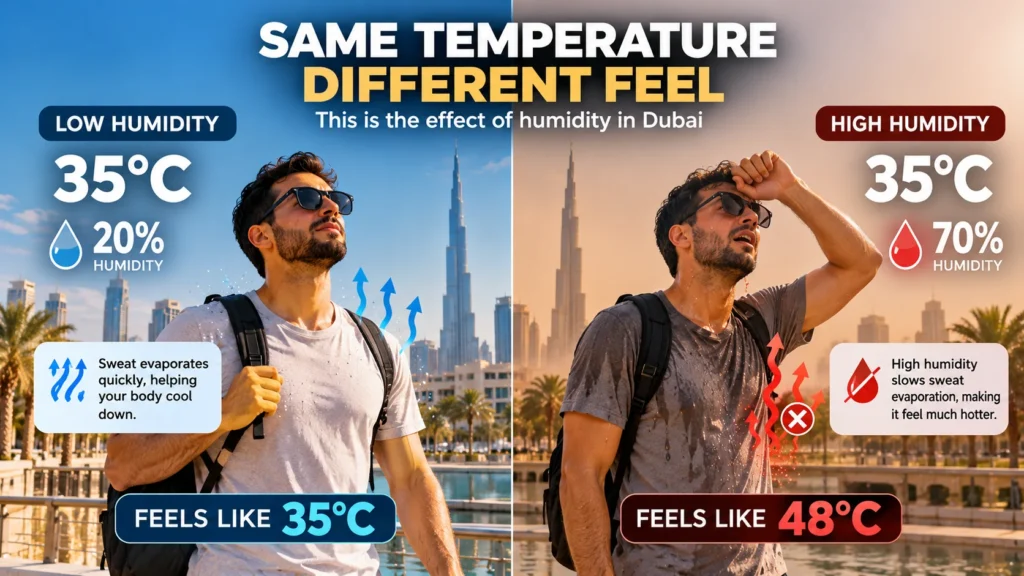
Your body relies partly on sweat evaporation to release heat.
When sweat evaporates from your skin, it removes heat and helps cool you down.
High humidity makes evaporation less effective. As a result, your body may struggle to cool itself even while you continue sweating.
This is why humid heat can feel more oppressive than dry heat at the same air temperature.
The US Centers for Disease Control and Prevention explains that moisture in the air can interfere with sweat evaporation, increasing the difficulty of staying cool.
Source: CDC: Managing Diabetes in the Heat
Actual temperature versus feels-like temperature
These measurements describe different things:
| Measurement | What it tells you |
|---|---|
| Air temperature | How warm the surrounding air is |
| Relative humidity | How close the air is to saturation at its current temperature |
| Dew point | An indication of the amount of moisture in the air |
| Heat index | A measure combining temperature and relative humidity |
| Feels-like temperature | An apparent-temperature estimate that may use different weather variables depending on the provider |
A weather app’s feels-like value is not necessarily calculated using the same formula as the US National Weather Service heat index.
Some apparent-temperature models also consider wind and other factors.
An example of humidity changing perceived heat
The US National Weather Service provides an example in which an air temperature of 96°F (approximately 35.6°C) combined with 65% relative humidity produces a heat index of 121°F (approximately 49.4°C).
That is an illustrative calculation, not a current Dubai weather observation.
It demonstrates why air temperature alone can seriously underestimate how uncomfortable hot, humid conditions may feel.
Source: National Weather Service: Heat Forecast Tools
Dubai Heat Index: What Should You Know?
The heat index estimates how hot conditions feel when temperature and relative humidity are considered together.
It is particularly useful in hot, humid weather, but it has limitations.
The standard National Weather Service heat index assumes shade and light wind. Direct sunshine can increase perceived heat beyond the index value. Physical exertion, clothing, individual health and access to cooling also affect heat risk.
This means a heat index reading should inform your decision, not replace common sense or official weather warnings.
For outdoor activities, consider:
- The actual air temperature and heat index.
- Whether you will be in direct sunshine or shade.
- How physically demanding the activity is.
- Your access to water, rest and a cooler environment.
- Current local weather and health advisories.
Source: National Weather Service: Heat Index Guidance
Dubai Humidity by Month: What Changes Throughout the Year?
Dubai’s humidity varies seasonally, but there is an important misconception worth correcting: the hottest month is not necessarily the month with the highest average relative humidity.
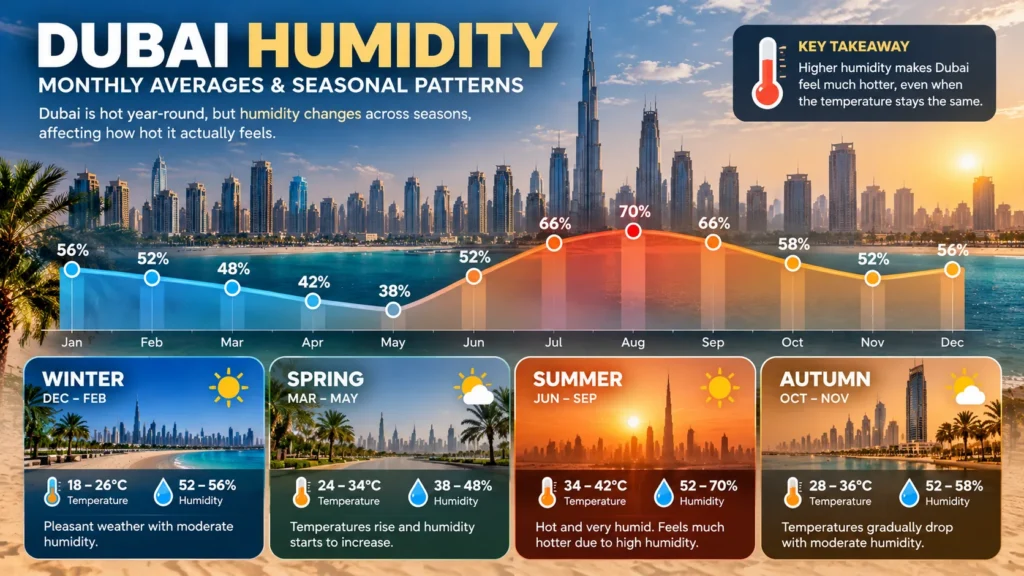
Relative humidity depends on both moisture and temperature.
Dubai’s official statistical records show substantial differences between monthly daily maximum and minimum relative humidity readings. In other words, humidity can vary considerably within the same day.
The UAE’s Federal Competitiveness and Statistics Centre also publishes monthly relative-humidity indicators for Dubai Airport and other weather stations.
A seasonal guide
| Period | General conditions | What to pay attention to |
|---|---|---|
| December–February | Cooler temperatures; humid mornings can occur | Morning moisture, fog and visibility |
| March–April | Temperatures generally rise | Changes in daytime heat and humidity |
| May–June | Increasingly intense heat | Heat exposure and evaporative cooling |
| July–August | Very hot summer conditions | Combined heat, moisture and outdoor safety |
| September–October | Heat gradually eases | Humid spells and changing daily conditions |
| November | Generally more comfortable temperatures | Day-to-day humidity and evening conditions |
These are broad seasonal descriptions, not a forecast or a claim that any particular month always has the highest humidity.
For a reliable numerical comparison, use a consistent station, reporting period and measurement type. Monthly average relative humidity should not be confused with the average daily maximum.
What About Dubai’s Humidity in November?
November is a useful example of why temperature and humidity should be considered separately. As Dubai moves away from the intense summer heat, mornings, evenings and outdoor sightseeing generally become more comfortable, although warm afternoons and humid periods can still occur. For travelers planning a visit, our Dubai in November 2026 guide explores typical temperatures, early versus late November conditions, what to wear, beach activities and practical travel costs. It provides the travel-planning context behind the climate patterns discussed here, rather than treating a monthly average as a guarantee of comfortable weather.
Historical data sources:
- Dubai Statistics Center: Average Relative Humidity, 2016–2018
- UAE Statistics: Climate and Relative Humidity Indicators
Why Can Dubai Feel Humid at Night?
Relative humidity often increases when the air cools, even without a large increase in the actual amount of water vapor.
That helps explain why humidity readings can rise after sunset or during the early morning.
But a higher nighttime humidity percentage doesn’t automatically mean conditions are more dangerous than during the afternoon.
Heat exposure depends on the combined conditions, including temperature, moisture, wind and physical activity.
On particularly warm nights, however, high humidity can make it harder to cool down comfortably, especially without adequate ventilation or air conditioning.
Does Humidity Affect the Best Time to Visit Dubai?
Humidity is one factor in choosing when to visit Dubai, but it should not be considered in isolation. Summer can bring intense heat and uncomfortable outdoor conditions, while the cooler months generally offer more flexibility for sightseeing, walking and desert excursions. Travelers should also consider rainfall patterns, accommodation costs, crowds and the activities they want to enjoy. Our Best Time to Visit Dubai in 2027 guide compares all twelve months using historical weather patterns alongside travel costs and seasonal considerations, helping visitors choose a period that suits their priorities rather than relying on temperature alone.
How to Check Dubai Humidity Today
Before heading outdoors, look beyond the temperature displayed at the top of your weather app.
A useful Dubai weather check should include:
- Current temperature: How hot is the air?
- Relative humidity: How moist is the air compared with saturation?
- Feels-like temperature: How uncomfortable might the combined conditions be?
- Hourly forecast: Are conditions expected to improve or worsen?
- UV index and air quality: Are there additional reasons to adjust outdoor plans?
You can explore current conditions and forecasts through GenWeather.
Historical averages explain Dubai’s climate, but they cannot tell you exactly how the air feels right now. For a more useful picture, check the current humidity alongside the temperature, dew point and feels-like reading. The live Dubai weather forecast on GenWeather brings these measurements together with hourly temperature changes, wind conditions and air-quality information. Comparing them can help you understand whether the day is simply hot, unusually humid or affected by additional environmental factors. Always check the observation time, especially when planning an outdoor activity.
How to Stay Comfortable During Humid Weather in Dubai
Humid heat deserves attention, especially during prolonged outdoor activity.
The CDC recommends staying cool, remaining hydrated and recognizing signs of heat-related illness.
Practical steps include choosing cooler periods when possible, taking breaks in air-conditioned environments, wearing suitable lightweight clothing and reducing strenuous activity during excessive heat.
Pay attention to warning signs such as dizziness, headache, nausea and unusual weakness. Heat stroke is a medical emergency, particularly when confusion, collapse or altered consciousness occurs.
No particular humidity percentage can guarantee that outdoor conditions are safe. Risk depends on the full environment and the individual.
Sources:
Frequently Asked Questions
Is Dubai humid all year?
Dubai can experience humidity throughout the year, but the level varies by season, time of day and weather conditions. A single annual percentage cannot describe every location or hour.
Why is Dubai so humid despite being a desert city?
Dubai has a desert climate, but it also sits beside the Arabian Gulf. Moisture from the sea can influence local humidity, particularly when winds carry moist air inland.
Is 70% humidity high in Dubai?
A reading of 70% indicates relatively moist air for the current temperature. Whether it feels uncomfortable depends heavily on the air temperature and other conditions. A cool morning at 70% humidity is different from a hot afternoon at the same percentage.
What is the difference between Dubai humidity and the Dubai heat index?
Humidity describes atmospheric moisture relative to saturation. The heat index combines air temperature and relative humidity to estimate perceived heat under specified conditions.
Is Dubai more humid in summer or winter?
It depends on which measurement you compare. Relative humidity can be high during cooler months and mornings, while the combination of summer heat and moisture can create more severe heat stress. Historical monthly averages and daily maximums should be examined separately.
Does humidity make Dubai feel hotter?
In hot conditions, higher humidity generally reduces the effectiveness of sweat evaporation, which can make it harder for the body to cool itself. Sunshine, wind and physical activity also matter.
Final Thoughts
Dubai’s heat is easy to measure, but understanding how it feels requires more than a temperature reading.
Humidity, dew point, heat index, sunshine and wind all help explain why one day may feel comfortable while another becomes exhausting.
For residents and visitors, the most useful habit is to check the complete weather picture before making outdoor plans.
Temperature tells you how hot the air is. Humidity helps explain why that heat may feel very different.